Sunday, March 23, 2014

A New Unit (Chapters 16-19 Assignment D) ***

Throughout the book, reliance on others has been vital to the survival of all the migrants. Before embarking on their trip across the country, the members of the Joad family depended on one other as they all had specific expertise needed to complete the trip. For example, Al was the only mechanic in the family who could ensure the car was working well, and Ma was the cook who kept everyone going. The had no choice, family was the only thing the people had after leaving their homes. Since there was no one else left in Oklahoma, this family unit came to represent all the people harmed from the dust bowl.

After the migrants were on the road for some time, the reliance on others grew to include every traveler in the same circumstances as the family. Steinbeck describes the cars of the migrants:

"In the daylight they scuttled like bugs to the westward; and as the dark caught them, they clustered like bugs near to shelter and to water... They huddled together; they talked together; they shared their lives, their food, and the things they hoped for in the new country. In the evening a strange thing happened; the twenty families became one family, the children were the children of all... They grew to be units of the camps" (193). 

Having experienced the same hardships and unfair treatment by the wealthy, the travelers all stuck together in camps. They needed each other for moral support, and had to understand that there were other people in the same boat as they were. It is ironic that they "scuttle like bugs" to the shelter and water of the land, because the rich see them as bugs. However, they have not lost the qualities that make people human--the ability to share stories and help one another. The Joad family, which was once its own contained unit, now benefits from becoming a part of a much bigger unit with many families. All the separate families needed things that other families had, like food, gas, water, or household goods. Because of this, in the end everyone shared and everyone benefited. In this way, these units of camps successfully spread the wealth among everyone, something that the government could not do across the entire country.

The government not only failed to spread the wealth, but it even harmed the poorest citizens. In chapter 20, cops were sent by the wealthy owners in California to burn down the migrant camps because the rich are threatened by the strong communities. The growing number of wage workers start to band together to put on strikes and oppose the inequality, so the rich pay the cops to keep this growing wrath down. They will do anything to keep the wealth inequality present in the country because of man's natural greed.

Monday, March 17, 2014

The Unspoken Rules of Society (Chapters 16-19 Assignment A) ***


One of the most important rules in the migrant's camps is the right to keep the past black hidden in the heart. As these camps are filled with people who were recently forced out of their homes, depression and sadness must have been common. People were filled with harsh, painful memories of being forced to leave loved ones and loved items behind. In a camp like this, everyone would lose all motivation to continue if they dwelled on reminiscing about the past. The right to keep this memories to oneself disallowed anyone to question others about their past. It kept people sane and offered hope to the future, the only thing to look forward too.

Another very important rule in the camps was the right of the hungry to be fed. Most families, at some point along the trip, ran out of food or ran out of money to get new food. During these times, everyone had to pitch in food for everyone to eat. If they didn't, death from starvation would have been much more common. The final rule adds on to this, stating that it is unlawful to eat good food next to a hungry person. All of the travelers have already experienced the pain that comes from an unequal distribution of wealth, since the immensely rich banks forced all the migrants into poverty. Now, in the camps, no one wants to experience the same unfair distribution. The relatively rich, who are lucky enough to have food, must not flaunt their wealth to the starving poor.

Motif of Selflessness (Chapters 11-15 Assignment G)

To highlight how capitalism, which forces people to become greedy and only think about themselves, is really detrimental to society, Steinbeck presents the reader with multiple instances where acts of selflessness help everyone involved. On a larger scale, the large corporations, especially the banks, work for the sole purpose of amassing wealth. This benefits the few people lucky enough to hold high positions in the corporations, but at the cost of many more people being impoverished. On a smaller personal scale, which is most prevalent in The Grapes of Wrath, people do best when they think as a whole community instead of themselves.

For example, chapter 14 is from the point of view of travelers who all need things that other travelers have. One kind-hearted act is described: "The night draws down. The baby has a cold. Here, take this blanket. It's wool. It was my mother's blanket--take if for the baby. This is the thing to bomb. This is the beginning--from 'I' to 'we'" (152). In the harsh conditions on the road, the migrants have to lose the idea that they can make it on their own if they want to survive. Even very personal belongings, like the mother's blanket, have to be given up for the greater good. Steinbeck's overall message here is that the most prosperous society comes from a community that shares everything. When trying to overcome a problem, the "I" mentality of oneself first needs to develop into the "we" mentality that leads to success for everyone.

In the next chapter, a similar theme of selflessness arises, but it holds a different message. When a homeless father with no money comes into a cafe begging for cheap bread, the waitress, Mae, initially refuses. However, her boss, Al changes her mind. "The man put his hat back on his head. He answered with inflexible humility, 'Won't you--can't you see your way to cut off ten cents' worth?' Al said snaringly, 'Goddamn it, Mae. Give 'em a loaf'" (160). After she gave food away for a better deal to someone in need, other men sitting in the cafe noticed and decided to show their appreciation by leaving a very large tip. In this case, Steinbeck suggests that acting selflessly not only helps everyone else, but the charitable person also benefits greatly.

Wednesday, March 12, 2014

Highway 66 in the 30's (Chapters 11-15 Assignment B)

Throughout the 1930's, the thousands of migrants traveling cross country on route 66 made the road a very long historic monument to America. As the best means of leaving the dust bowl and poverty behind, it symbolized a road to opportunity for all of the travelers. The map below shows the major cities that the road passes through, many of which were mentioned in The Grapes of Wrath. To the Okies looking to find work and start over, route 66 offered the only potential way to success. Because of this, Steinbeck called it "the Mother Road," a protective figure to the poor and hopeful. 


Most of highway 66 traverses through very flat, dry land. There are long sections with almost no turns and no mountains, and very little vegetation. This can be seen in the picture below:


Many businesses along the route prospered from the influx of customers. Many gas stations sprang up to meet the demand of gas that the inefficient cars needed, like the one shown in the picture above. Mechanics also opened businesses along the road to take advantage of the junky cars. These mechanics sold highly overpriced, used parts to the travelers, and the poor families had no choice but to pay to keep the car working. This can be seen in chapter 12 in The Grapes of Wrath, when a family stops at a service station to buy another tire. The seller attempted to hide that the casing of a tire was in very bad condition, but when the buyer found out the price was decreased by very little. Scenarios like this reveal how immoral man is other men when people are in desperate conditions and vulnerable.

Towns grew surrounding the road during the thirties to sell goods to the traveling customers. Drugstores, like the one in the picture below, sold small basic necessities for travel. Other stores sold stale food that was the best the Okies could afford.


More info: here!

Friday, March 7, 2014

A Farmer's Worst Enemy (Chapters 1-10 Assignment G) ***

Throughout the first ten chapters of The Grapes of Wrath, before the Joads leave Oklahoma, the struggle between man and machine is shown to be a major theme. The innovations that only a few months earlier helped the farmers and increased profits now force them off their lands and are only affordable to the banks. Everyone who worked the land by hand eventually lost their jobs to the banks, who employ only a few tractor drivers that can't pass up on the good pay. Steinbeck describes these past farmers and current wage workers:

  "The driver sat in his iron seat and he was proud of the straight lines he did not will, proud of the            tractor he did not own or love, proud of the power he could not control. And when that crop grew,        and was harvested, no man had crumbled a hot clod in his fingers and let the earth sift pas his                fingertips. No man had touched the seed, or lusted for the growth. Men ate what they had not raised,      had no connection with the bread." (36)

The machines distance the farmers from the ground, since they literally ride above it, causing all connection between the farmer and his crops to be lost. The working men will no longer know that everything they produced came directly from their own manual labor, but instead mostly come from the work of the machine. They will be forced to feel "proud of the straight lines [they] did not will [...] proud of the power [they] could not control" because they had to be proud of their property that could not be credited solely to the men. Having to work the land by hand also ensured work for everyone, because there is no one person who can work an entire valley of fields by his/her self.


One tenant, who was kicked off his land, tried to think of a way to solve the taking over of machines. He considers:

"'There's some way to stop this. It's not like lightning of earthquakes. We've got a bad thing made by men, and by God that's something we can change.' The tenant sat in his doorway, and the driver thundered his engine and started off [...] The iron guard bit into the house-corner, crumbled the wall, and wrenched the little house from its foundation..." (39)

Without the knowledge of how widespread the problem with the machines was, this tenant believes that everything man made can be stopped by man. The machines are taking over all the work that was the sole income for these tenants. However, the machines are doing more and better work than the humans are, so no one other than the farmers want the tractors to be stopped. The tractors farm better than the farmers do, so now there is now way for the homeless to stop it. Now hopelessly helpless, the farmer is hurt as badly by the machines as he is by the drought that killed his crops.

Thursday, March 6, 2014

Jim Casy, or the New Jesus? (Chapters 1-10 Assignment F)

John Steinbeck was a heretic in his time who tackled the controversial topic of religion. Throughout the first ten chapters, the character of Jim Casy is used to question the idea that one God exists and men have to refrain from sinning if they hope to go to heaven. After retiring from being a preacher after sleeping with women in his congregation, Casy questioned his faith, and then seems to have reached a higher level of philosophical views. Instead of believing in the normal facets of Christianity, he unknowingly turned to the Transcendentalist idea of the oversoul. He reveals his revelation:

"'maybe it's all men an' all women we love; maybe that's the Holy Sperit--the human sperit--the whole shebang. Maybe all men got one big soul ever'body's a part of.' Now i sat there thinkin' it, an' all of a suddent--I knew it. I knew it so deep down that it was true, and I still know it.'" (pg 24)

Casy's new belief follows the exact definition of the oversoul, that all men are part of one "human sperit." There is no more God or heaven higher than earth, but instead one overarching spirit that encompasses everyone. Later, at the table with the Joad family, Ma Joad asked Casy to say a prayer. At  first he refused, since he was not a preacher anymore, but eventually he gave in. He said:

"Sometimes I'd pray like I always done. On'y I couldn' figure what I was prayin; to or for. There was the hills, an' there was me, an' we wasn't separate no more. We was one thing. An' that one thing was holy." (81)

As a retired preacher, Casy is used to thinking that the only holy things are greater than earth. However, he now realized that the real, earthly things actually are what is holy, and he needn't look any further. His faith seems to have turned to a faith in the land and the world. This is ironic, because Casy only came to this realization when the land became dry and forced him into poverty.

In an allusion to the bible, Steinbeck gave the preacher the name of Jim Casy, with initials J.C. to suggest that Casy is the real Jesus Christ (the other J.C.). I predict that the old idea of Faith will continue to be challenged throughout the book, mostly due to this character.

More info on Casy and religion in the book can be found here

Wednesday, March 5, 2014

Vehicles of the 1930's (Chapter 1-10 Assignment D)

The automobile industry experienced its best year ever in 1929, selling over five million vehicles. However, the 1930's reversed the growth of car manufacturers with the economic downturn from the great depression. By 1932, only 1.3 million cars were being sold yearly, a near 80% decline from three years before. The sudden decrease of consumers also hit the smaller car manufacturers the most, who could not afford the drop in sales. Ford, GM, and Chrysler jumped to owning 90% of the market in the 30's when in the previous decade they only had 75%. This put many of the less wealthy companies out of work, leaving the biggest companies with much more of the market. With less competition, the few remaining dealerships could control the entire industry.

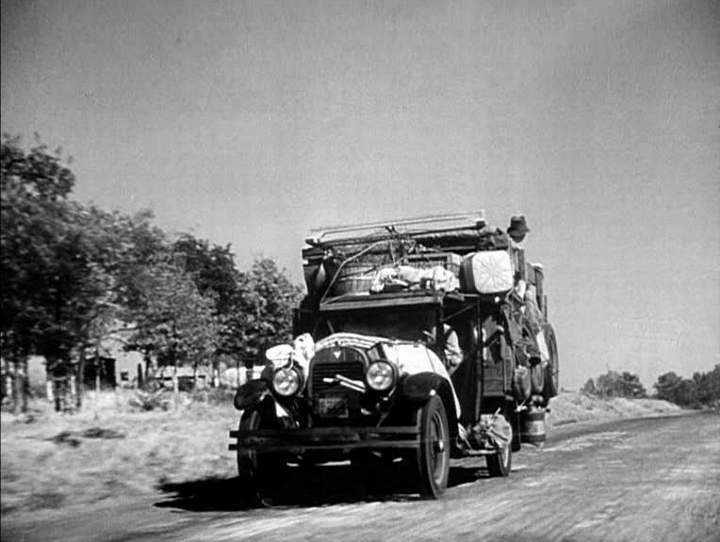
In The Grapes of Wrath, chapter 7 is from the point of view of a cheap car salesman trying to sell old broken cars for a very inflated price. Oklahoma, where Joad's family is located in chapter 7, was hit especially hard in the depression from the dust bowl, and most of the cars left there were in very bad condition. The cars sold at dealerships were meant to only run until the family was out of the city and could not hold the dealership responsible. In chapter 8, the car that Joad's family is planning to take to California is said to be a hudson super six sedan. It looked something like this:


These cars, with the back of a truck, would hold all the possessions of a family and all the family members. In the bottom picture, multiple people can be seen hanging off the back of the car. It clearly was not the ideal way to cross the country, but it was the best that the farmers could afford. 


Saturday, March 1, 2014

Hugh Bennett -- A Little Known Soil Conservationist (Chapt. 1-10, Assignment A)

     One of the most striking descriptions in the first chapters of The Grapes of Wrath is of the land during the dust bowl. With all the topsoil gone and no nutrients left, I wondered how this previously fertile land could ever recover. Even if the drought ended, the important nutrients could not return through the rain.
     After researching this topic, I found that one man was indispensable to the recovery effort. Hugh Hammond Bennett, a soil scientist, organized groups that helped bring nutrients back and keep the soil from blowing away. Bennett had studied soil all across the country, and he realized that Oklahoma needed more trees with strong roots to keep the soil in place.

Hugh Hammond Bennett

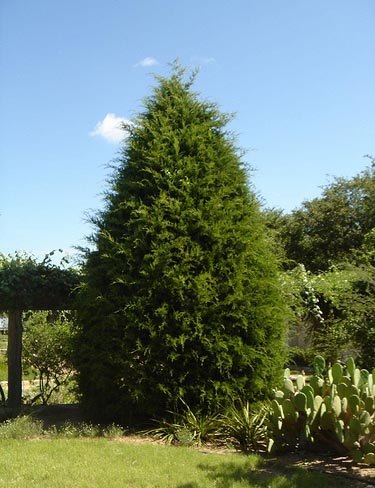
     To get the work started, following Bennett's advice, Roosevelt passed the Soil Conservation Act in 1935. This called for two hundred million native red cedar and green ash trees to be planted throughout the dust bowl area. These types of trees were very bushy, which made them great wind breakers for the surrounding soil. The new trees also brought nutrients to area, since when a tree dies, all of its nutrients go back into the soil. Not only was the soil helped by this act, but the remaining farmers were too; anyone who used a soil conservation method was paid a dollar per acre.

Wind Breaking Red Cedar Tree

Bennett's efforts proved to be successful, as there was a 65% reduction in the amount of soil blowing away by 1938.

This project was very interesting to me because of how drastically the environment was changed by humans in such a short period of time. Using science and the incentive of money, the government was able to improve something that had been near to a natural disaster. Contrary to the image that we saw of the high gas prices due to taxes, I know think that the government did more good than harm. I predict that the novel will leave out any indications that the farmers were helped, because Steinbeck tried to increase sympathy toward the plains farmers.